Where The Deer And The Antelope Play

The S&P 500 entered a trading range on February 2.  Inside a range, it is always prudent to run through a handful of potential outcomes, allowing us to have a strategic, psychological, and tactical road map.  Road maps help us stay calm during stressful events. 

short-takes-trading-range-29o.png


  • If a new bear market has started (TBD), we know with 100% certainty the S&P 500 would have to make a SUSTAINED move below the bottom of the range (2,532).
  • If the bull market is simply on pause (TBD), we know with 100% certainty the S&P 500 would have to make a SUSTAINED push above the top of the range (2,801).
  • Therefore, new information, from a price perspective, comes with a sustained push above the top of the range or a sustained push below the bottom of the range.  
  • We learn very little as price whipsaws up and down inside the range. 

To move outside the range on Wednesday, March 21, the S&P 500 would have to gain 85 points or drop 184 points.  Since those are pretty big moves, the odds favor closing inside the range after the Fed announcement (TBD).  

As outlined in numerous posts, the facts that we have in hand today (weight of the evidence on multiple timeframes), favor the SUSTAINED move occurring to the upside in a bullish manner.  As we know, a lower probability outcome (new bear market) is always a possibility, which speaks to remaining open to all outcomes (day by day). 

Even under a longer-term bullish resolution, it is possible the market will want to retest the S&P 500 low of 2,532.  From a psychological perspective, it is also prudent to keep in mind that retests often involve a false breakdown. 

A false breakdown could take the form of a relatively short stay (few minutes/hours/days) below 2,532, followed by a sharp and bullish reversal.  Obviously, a move below 2,532 would be a high anxiety event for many, and thus, it is prudent for us to take a calm and measured approach  if the S&P drops below 2,532 for a short period of time.  That is why the term sustained is so important when price is in a range.   

Under the low probability scenario (new bear market), the longer the S&P 500 stays below 2,532, the more meaningful it would become relative to increasing bearish odds.  

The market was unquestionably in a strong bullish trend before the recent correction.  Therefore, until proven otherwise, the base case remains a normal pullback/consolidation/resumption of bull market in the weeks/months ahead.  That is not a forecast; simply a probabilistic statement based on the facts in hand.  The term base case implies bearish cases must also be respected and accounted for (maximum flexibility). 
Volatile Periods Can Produce Satisfying Returns

VOLATILITY IS NEVER FUN

It would be great if the stock market moved in a consistent manner allowing us to calmly watch our account balances grow.  Unfortunately, enduring volatility is a necessary evil for those looking to capture long-term investment gains.

VOLATILITY IS NORMAL

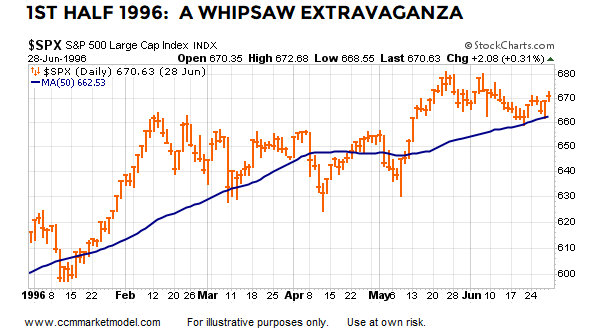
Calendar year 1995 featured a very strong trend in the S&P 500, similar to the strong trend that was present in 2017.  We are all familiar with the expression the market needs to consolidate its gains, which is exactly what happened in the first six months of 1996.  Between January 1, 1996 and June 30, 1996, the S&P 500 had 34 trading days that featured a move to or below the 50-day moving average.  Easier markets (1995) are typically followed by harder markets (1H 1996).

ccm-short-takes-ciovacco-1995-1H-V.png


CONSOLIDATION FOLLOWED BY ADDITIONAL GAINS

Harder markets (1H 1996) are typically followed by easier markets (2H 1996 - see chart below).  While the second half of 1996 was easier than the first half, it was still no volatility cake walk.  Between June 30, 1996 and December 31, 1996,  the S&P 500 had 32 trading days that featured a move to or below the 50-day moving average.

short-takes-ciovacco-capital-1996-2h.png

DESPITE VOLATILITY, FULL-YEAR GAIN OF OVER 20%

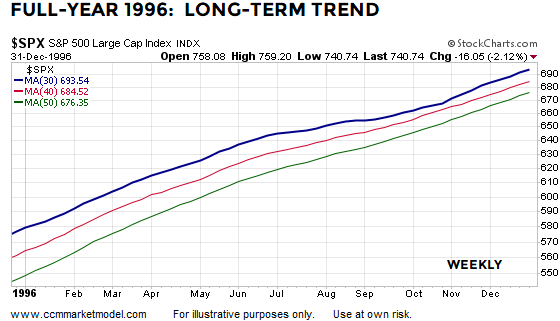
While the intermediate and short-term trends were volatile, the long-term trend remained intact, allowing the S&P 500 to gain 20.26% for calendar year 1996.   The weekly chart of the S&P 500 below shows the 30, 40, and 50-week moving averages to illustrate basic concepts. 

ccm-short-takes-ciovacco-capital-1996-fy.png

MARKETS ARE DIFFICULT

As shown via the charts below, trying to avoid volatility can be next to impossible in the financial markets if you wish to book satisfying gains at the end of the year.  Under our approach and timeframe, it is best to make decisions based on the weight of the evidence, including multiple timeframes, asset class behavior, and risk-on/risk-off ratios. 

stock-market-volatility-ccm-1996-z.png

MULTIPLE-YEAR VOLATILITY PROFILES DURING BULL MARKETS

Have you ever looked back after the market gains 20% and said to yourself how did I not capture more of that move?  Did you look back after the 2000-2002 or 2007-2009 bear market and ask yourself how did I let myself lose that much money? This week’s video explains why those horrible experiences are so common in the stock market and covers methods to minimize the odds of repeating past investing missteps.

VIDEO CORRECTION: At the 13:31 mark, the summary table for CASE B should be 56% and 44% as shown here.

The Key Difference Between Capturing Big Gains And Big Losses In The Stock Market

FINE LINE BETWEEN WINNING AND LOSING

Have you ever looked back after the market gains 20% and said to yourself how did I not capture more of that move? 

Did you look back after the 2000-2002 or 2007-2009 bear market and ask yourself how did I let myself lose that much money? 

This week’s video explains why those horrible experiences are so common in the stock market and covers methods to minimize the odds of repeating past investing missteps.

VIDEO CORRECTION: At the 13:31 mark, the summary table for CASE B should be 56% and 44% as shown here

Markets Look To Complete Important Bullish Step

CLUES BACK IN FEBRUARY

A February 26 post outlined the longer-term risk-on implications of trend flips in the stock (SPY) vs. bond (TLT) ratio and the tech (VGT) vs. bond (TLT) ratio.  Rather than having growth-oriented stocks making a new high relative to defensive-oriented bonds, we would expect bonds to be leading in a "fear of a recession and bear market" scenario as shown on February 5.  The chart below favors bullish probabilities. 

short-takes-3-12-18-d.png

S&P 500 TRYING TO REGAIN BULLISH FORM

When a market corrects and enters a short-term downtrend, three things need to happen for the primary bullish trend to regain control.  Step 1 is breaking above a downward-sloping trendline (see chart below).  Step 2 is making a higher low above the previous lowest low.  Step 3 is making a higher high.  The S&P 500 closed above 2,779 on March 9. 

short-takes-3-12-18-a.png

A close back below 2,779 does not negate the short-term bullish and probability-related progress; for that to occur the S&P 500 would have to make a lower low below the Step 2 point (2,677) in the chart above, which is entirely possible.

The further the S&P 500 moves above 2,779 in the days and weeks ahead, the more meaningful it would become from a bullish perspective.  Conversely, the further the S&P 500 moves below 2,677, the more meaningful it would become from a bearish perspective.  Nothing is binary in the financial markets. 

TECH STOCKS REGAIN 100% OF CORRECTION DRAWDOWN

Tech stocks were a leading market sector before the 2018 correction, as noted back in June of last year.  Typically, it is a good sign for the broader market when economically-sensitive leaders resume their leadership, which is exactly what has happened in recent weeks.  The NASDAQ printed a new all-time high on Friday, March 9, 2017.

short-takes-3-12-18-b.png

DO THE CHARTS SUPPORT THE BEARISH HYPE?

This week's video objectively compares 2018 to a bullish period and a bearish period.  The video also follows the S&P 500's primary trend step-by-step between January 8 and March 8, allowing us to see the incremental impact of the recent spike in bond yields, tariffs, and Gary Cohn's resignation.  

INDUSTRIALS HAVE SOME WORK TO DO

Is it alarming that the Dow has not made a "step 3" higher high yet?  No, there is no market law that says all three major indexes must do everything in unison.  If we are 3 or 4 months down the road and the Dow is still treading water, then it would be more concerning.  To make a step 3 higher higher high, the Dow needs to close above 25,709.

short-takes-3-12-18-c.png

THE PRIMARY TREND REMAINS BULLISH

The charts above provide some odds-related insight into a resumption of the market's bullish primary trend.  Since we know it is not unusual for markets to bounce around in a volatile and confused manner after a waterfall decline, it remains prudent to take it day by day focusing on the health of the primary trend.  If the primary trend starts to wane, we will adjust as needed.