
THE HARD DATA

MARKET’S TAKE: MONDAY AND TUESDAY

In this week’s video, we noted our approach would be data dependent if the market stayed between the upper and lower bounds shown below. As of the close on Tuesday, November 6, we have fairly constructive candles in 6 of the last 9 sessions, which is in sharp contrast to the extremely rare selling pressure seen in October.

nov-6-2018-1.png

The S&P 500 has now successfully closed above both the 61.8% and 50.0% retracements.

nov-6-2018-2.png

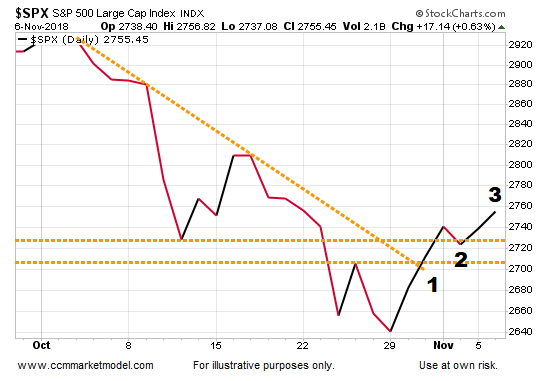
The S&P 500 closed back above all the “areas of possible support” we have been referencing for several weeks.

nov-6-2018-3.png

The S&P 500 has broken a downward-sloping trendline, made a higher low, and a higher high.
nov-6-2018-4.png

During Tuesday’s session, a basket of growth-oriented stocks outperformed a defensive-oriented basket of bonds by 0.62%.

nov-6-2018-5.png

Heading into election night, SPY is beating TLT by 0.85% this week. Point C looks similar to the constructive looks at points A and B.

nov-6-2018-6.png

The Dow printed a higher high today and RSI closed above 50 for the first time in several weeks.

nov-6-2018-7.png

The Global Dow, thus far, is holding above the 2007 high. This is an ongoing retest that may take some time relative to a firm resolution.

nov-6-2018-10.png

The NYSE, thus far, is holding above the 38.2% retracement. Price has moved back into the orange box.

nov-6-2018-11.png

SPY appears to be trying to make a stand near a logical area.

nov-6-2018-13.png

After being lopsided for several weeks, market breadth is showing some signs of improvement.

nov-6-2018-14.png

Many of the concepts above are covered in more detail in this week’s video.

TOMORROW IS A NEW DAY

Additional information about recent portfolio adjustments can be found on the CCM Twitter Feed.

Reference Points

SCARY CHARTS

Markets in free fall provide little in the way of guideposts and thus, parking some money on the sidelines is often the only way to prudently reduce unknowns until things settle down.

short-takes-oct-31-2018-a.png

MILE MARKERS

Corrections and the early stages of a new downtrend never fall into the easy-and-comfortable category and the last three weeks are no exception. When things calms down a bit, the market tends to give us some guideposts to assist in monitoring risk and tweaking allocations. Thankfully, unlike the waterfall chart above, the chart below helps reduce sheep-counting at night.

The look of Wednesday’s candlestick below tells us the session high of 2736 represents an area of possible short-term resistance. The long tail on Monday’s red candlestick tells us the session low of 2603 represents an area of possible support. Thus, we will learn something either way based on how market participants act near those levels in the future.

short-takes-oct-31-2018-av.png

Use of the upper (UB) and lower bounds (LB) will vary based on how the market behaves in the coming days/weeks (volume, signs of distribution, divergences, moves in the VIX, etc.).

PLANNING FOR THREE MAJOR SCENARIOS

We have to be able to account for three major hypothetical paths for stocks going forward:

A: A sharp bullish push higher

B: A sharp bearish drop

C: Sideways consolidation and whipsaws

short-takes-ciovacco-uunv90.png

The concept of maximum flexibility outlined in this week’s video and in Tuesday’s Short Takes post still applies. Clients can find numerous comments about current market conditions on the CCM Twitter Feed.

Illuminating Charts: Investing Timeframes

IF SEPTEMBER 2018 WAS A MAJOR HIGH

In 2018, we are 39 calendar days from the all-time S&P 500 intraday high that was printed on September 21, 2018. The chart below shows the S&P 500 index 39 calendar days after the highest high that was made on October 11, 2007.

short-takes-ciovacco-2007-peak-a.png

Was it “too late” to take defensive action 39 days after the 2007 major stock market peak? You can decide after looking at the “what happened next?” chart below. Point A in the chart above is the same date as shown via point A in the chart below.

ciovacco-short-takes-big-moves-23.png

IF TODAY WAS THE LOW

Stocks rallied on Tuesday, October 30, 2018 after three weeks of brutal selling pressure. Human nature being what it is, we all feel like we are missing something if stocks go up for a few days when we have some cash on the sidelines. The chart below shows the date of the 2016 market low after getting off to the worst ten-day start to a new year in stock market history.

short-takes-ciovacco-you-are-late-one2.png

In the 2016 chart above, notice how it is not uncommon for the stock market to push higher and then backtrack to retest the prior low, something that may or may not happen in 2018. Was all lost if you did not have 100% of your capital reinvested at point A above? The answer is obviously no when we look at the “what happened next?” chart below. Stocks rallied for over two years.

short-takes-ciovacco-late-3.png

MORAL OF THE STORY

No one knows how 2018 is going to play out. As noted in this week’s video, a fact-based case can be made for both the big-move-up and big-move-down theories. Typically (not always), if we can step back from the day-to-day swings in price and our emotions, we will have time to prudently get allocated in line with the evidence, regardless if the outcome is wildly bearish, as it was in 2007, or wildly bullish, as it was in 2016.

The vast majority of common investing and trading missteps are related to having a very short-term focus and making changes based on short-term fear. We have navigated to a very reasonable and flexible risk-reward posture in 2018. The market will eventually tip its hand in the “new downtrend” or “correction followed by a new uptrend” direction. If we can shift our focus to the bigger picture, the odds of success will increase significantly. If we remain focused on daily fluctuations and short-term outcomes, the odds of success will decrease significantly.

BUT 2018 IS DIFFERENT FROM BOTH 2007 AND 2016

The purpose here is not to compare 2018 to either historical period; we are simply illustrating basic concepts about trends, timeframes, and patience.