Similar Drops In ISM Manufacturing Data

RARE AND RAPID DROP IN ISM MANUFACTURING

ISM Manufacturing PMI Index came in well below expectations on October 1, 2019 sparking renewed fear of a recession.

short-takes-ccm-market-model-ciovacco-manufacturing-pmi-a.png

Given the ISM Manufacturing Index was strong in August 2018 and plunged rapidly to the October 1, 2019 level, it might be helpful to know how many similar drops from above the blue line to below the black line have occurred since 1982 and how did the stock market perform over the next five years? The answer to the first question is five previous times (see chart below).

short-takes-ccm-ciovacco-market-model-ism-maufacturing-pmi-c.png

The answer to the question how did the stock market perform over the next five years is “quite well”. In the first two years, 80% of the cases posted positive returns. All historical cases (1982-2019) posted gains after four and five years.

manufacturing-pmi-plunges-table-ccm.png

In the present day case, it took 1.08 years for ISM Manufacturing PMI to drop from the peak above the blue line to below the black line. As you can see in the table above, the three most similar “rapid drops in ISM Manufacturing PMI” cases were 1985, 1989, and 1995. The 2008 and 2016 cases required over four years to see a similar drop to what just occurred in a little over a year. If we isolate the similar “rapid plunge” cases, historical performance was more satisfying.

manufacturing-pmi-plunges-table-ccm2.png

The present day case has many unique circumstances and will follow a unique path. This study simply provides some additional historical context. The bearish case for a rapid plunge in manufacturing data is easy to understand and will get plenty of coverage. These studies, based on history, tell us to keep an open mind about all outcomes from wildly bearish to wildly bullish.

EXPANDED COVERAGE IN THIS WEEK’S VIDEO

This week’s CCM video will most likely provide additional context regarding the similar historical periods shown above. CCM’s weekly video is released every Friday evening between 6 pm ET and midnight. Weekly videos can be found via CCM’s Twitter Feed, CCM’s Blog Short Takes, or the Ciovacco Capital Channel.

BUT 2019 IS SIGNIFICANTLY DIFFERENT

You can make that argument about 100% of the historical studies performed about the economy and financial markets. No two periods in human and market history have the exact same combination of fundamentals, technicals, valuations, interest rates, inflation, etc. Today is always different; that is a constant in the markets.

WHAT ABOUT SMALL SAMPLE SIZES?

The limited sample size of the similar cases above is what it is. We cannot control sample sizes. There have only been three 40%-plus declines in the S&P 500 since 1950 (1973-74, 2000-2002, and 2007-2009), which also represents a very small sample size. Are we supposed to totally ignore these major declines because of the small sample size? According to Reuters, the S&P 500 was officially launched on March 4, 1957, meaning any S&P 500 study deals with a very limited historical data set. It is what it is.

When we study rare events, we acknowledge the sample size and try to learn anything that can add value in the present day. The same concepts apply to the studies above. There are countless economic and market studies that are based on small sample sizes. Typically, the small sample size argument is only raised when the results run counter to someone’s personal opinion. When results agree with someone’s personal view, the small sample size is suddenly not a problem. If you believe a study or data set is irrelevant, there is an easy solution - ignore it.

This post is written for clients of Ciovacco Capital Management and describes our approach in generic terms. It is provided to assist clients with basic concepts, rather than specific strategies or levels. The same terms of use disclaimers used in our weekly videos apply to all Short Takes posts and tweets on the CCM Twitter Feed, including the text and images above.

Trade, Impeachment, And The Conviction Of Buyers And Sellers

ROLLOVER PROCESS 2007-2008

Since every trade has a buyer and a seller, price action in the financial markets is determined by the conviction of buyers relative to the conviction of sellers. In the first half of 2007 (chart below), the conviction of buyers became stronger than the conviction of sellers allowing the S&P 500 to hold above the red 200-day moving average. In the second half of 2007, the conviction of sellers began to gain traction relative to the conviction of buyers causing the S&P 500 to stall and eventually drop decisively below the 200-day moving average.

short-takes-ciovacco-spx-200-ccm-market-model-2007.png

When the S&P 500’s trend rolled over in a decisive manner in 2008:

  • Price tended to stay below a downward-sloping 200-day moving average.

  • There was noticeable white space above price and below the 200-day.

DOES THE 2019 CHART ALIGN WITH GLOOM AND DOOM?

The right side of the 2006-2008 chart above looks quite a bit different from the present day S&P 500 chart shown below. In recent months, price has stayed above an upward-sloping 200-day moving average and there has been white space below price and above the 200-day.

short-takes-ciovacco-spx-200-ccm-market-model.png

If we move from left to right on the chart above, the conviction of sellers was not strong enough in early 2018 to drive the S&P 500 below the red 200-day for a prolonged period. Institutions became more concerned in early October 2018 and selling conviction picked up considerably relative to buying conviction. Once price cleared the 200-day in Q1 2019, the conviction of sellers has not been strong enough to hold price below an upward-sloping 200-day.

IT HAS BEEN 119 DAYS SINCE…

In the end, bear markets begin when large institutions decide the fundamental issues of the day have reached a negative tipping point and it is time to head for the exits (as they did in Q4 2007 and in 2008). Large institutions have known about slowing global growth, yield curve inversion, trade tensions, and the threat of impeachment for some time now, and yet selling conviction from institutions has not been strong enough to drive the S&P 500 below the 200-day moving average for 119 calendar days.

short-takes-ciovacco-spx-200-ccm-market-model-2007C.png
Institutions are aware of impeachment odds.

Institutions are aware of impeachment odds.

When institutions believe it is time to significantly reduce risk exposure, instead of having an S&P 500 chart with price above an upward-sloping 200-day, we will see an S&P 500 chart with price below a downward-sloping 200-day. That may happen in short order, but it has not happened yet.

YOU CAN DECIDE WITH FUNDAMENTAL AND TECHNICAL FACTS

This week’s stock market video addresses the following questions:

  • What are the odds President Trump is removed from office?

  • Are the credit markets screaming “imminent recession and imminent defaults?”

  • Is market breadth waving “pay attention” flags?

  • Do odds favor an ugly monthly labor report?

  • Are high-yield bonds acting like they did in 2007-2008?

YIELD CURVE HEAD FAKES IN BRITAIN

History tells us 10-2 year yield curve inversion is something that needs to be respected from a bearish/recession perspective. However, after the first sign of 10-2 yield curve inversion in the last two cycles, the S&P 500 gained an average of 30.57%.

yield-curve-inversion-ciovacco-short-takes.png

The Wall Street Journal noted in an article, U.K. Experience Suggests an Inverted Yield Curve Isn’t All Gloom and Doom:

Every time the U.S. 10-year Treasury yield has sustained a drop below the three-month T-bill since the 1970s, a recession has followed. There have been no false positives.

In the U.K., a decline in the yield on 10-year gilts (as British government bonds are known) below the two-year has foretold the last three recessions in that country. (Yield curve analysis in Britain focuses on the two-year gilt on the short end.)

The U.K. yield curve also inverted in the mid- and late 1980s with no recession occurring soon after. It was inverted for the better part of 1998 to 2002. Recessions hit elsewhere, including the U.S. and Russia, but the U.K. economy held up and even boomed for some of that time, helping to earn the “Cool Britannia” nickname.

2019: DAY BY DAY

Until the S&P 500 is able to break out convincingly and in a sustainable manner above 3025, it is extremely important under our approach to keep an open mind about all outcomes, from wildly bullish to wildly bearish. If the data shifts in a meaningful way, we must be open to reassessing bull/bear probabilities.

The Road Ahead May Be Brighter Than Expectations

THE BIG PICTURE

Recent data seems to cast doubt on the seemingly never-ending call for an imminent recession. From a September 20, 2019 Bloomberg article:

“The U.S. economy is outperforming expectations by the most this year, offering a fresh rebuttal to last month’s resurgent recession fears fueled by the trade war and a manufacturing slump. The Bloomberg Economic Surprise Index has reached an 11-month high after four indicators released Thursday, including existing home sales and jobless claims, each surpassed expectations.”

The Global Dow seems to support the “it is not that bad” theory. The index has thus far held above an important area of possible support.

ccm-market-model-ciovacco-capital-gdpw1.png

SIMILAR PATTERNS IN 2011-2012 AND 2015-2016

It was not difficult to find calls for an imminent recession in both the 2011-2012 and 2015-2016 periods (see dated headlines below).

recession-headlines-2012-2016.png

In both periods there were legitimate reasons to be concerned and significant corrections in global stocks, similar to the October-December 2018 period. With economic data starting to exceed expectations, it is possible global stocks will break out as they did following corrections in 2011 and 2015.

ccm-market-model-ciovacco-capital-gdpw2.png

ECONOMIC DATA AND BONDS

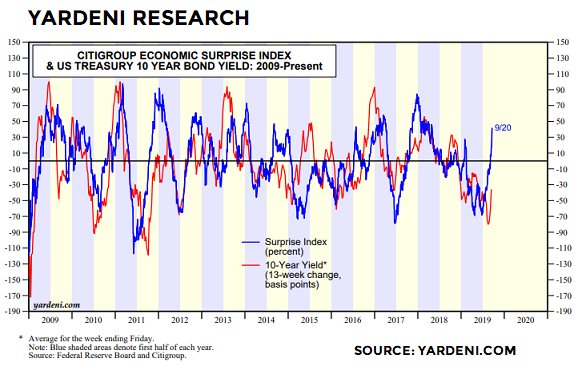
The Yardeni Research chart below shows the Citigroup Economic Surprise Index in blue and the yield on a Ten-Year Treasury in red. Low yields typically align with economic fear. Given the recent improvement in economic data, it is possible yields will once again follow the Economic Surprise Index higher.

economic-surprise-index-2019-09.png

Data related to the U.S. economy has been improving for some time now allowing the Economic Surprise Index to gain meaningful traction. From a September 10, 2019 CNBC article:

“The Citi Economic Surprise Index, after nearing its lowest level in two years in June, this week was at its highest point since February. The index looks at actual economic readings against consensus forecasts, so it will rise when expectations are too low and fall when optimism runs too strong. The latest move, then, can be seen as a recalibration of Wall Street’s overriding pessimism.”

SETUPS IN PLACE FOR MONSTER BREAKOUT

While China remains an obvious and important wildcard, this week’s stock market video provides numerous forms of evidence that tell us to remain open to much better than expected outcomes over the next twenty-four months. Topics covered include: the labor market, Fed, long-term S&P 500 trends, valuations, breadth thrusts, better than expected economic releases, credit spreads, sentiment, and the VIX.