

The Message From Common Stock Market Retracement Levels
RETRACEMENTS SPEAK TO ODDS
If we are to believe the market’s rally off the December 2018 low is the last hurrah, we would expect to see some damage on the normal retracement front. Using the last rally into the S&P 500’s major October 2007 peak as an example, if the uptrend was in good shape any pullback or correction would typically remain above the A to B retracements shown below. Our purpose here is not to compare 2007 and 2019 head-to-head, but rather to use the chart below to illustrate basic concepts about trends and retracements.
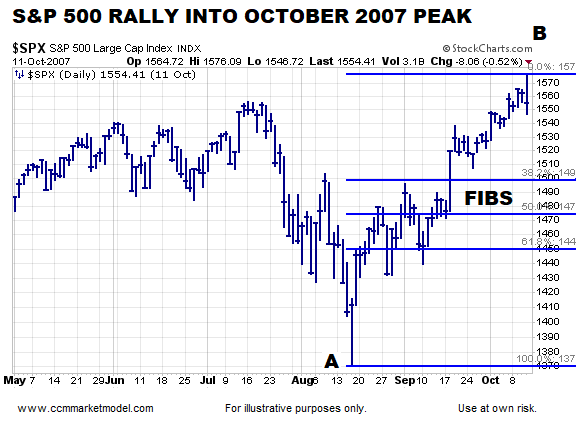
The odds of a new and sustained downtrend forming increase when the market is unable to hold near the three common retracement levels, which is exactly what happened between October 2007 and January 2008.

HOW DOES THE RALLY OFF THE DECEMBER 2018 LOW LOOK?
How concerned are institutions about slowing global growth, recent weakness in U.S. economic data, and the threat of impeachment? As of this writing, not concerned enough to cause the S&P 500 to take out any of the major retracement levels based on the A to B move off the December 2018 low. Since the S&P 500 July 2019 peak, price has not touched any of the three retracement levels.
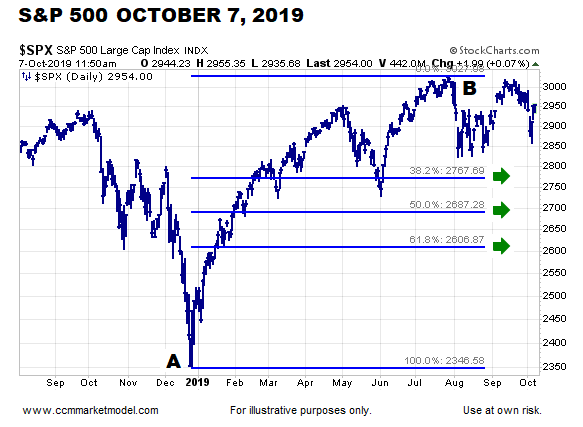
If the rally off the December low is the last move in the current bull market (which may be the case), we should see the S&P 500 eventually move below all three levels shown above. That may indeed happen but it has not happened yet. We will learn something either way (bullish or bearish) in the coming days and weeks. There is nothing magical about retracements; they simply help us assess the probability of bad things happening relative to the probability of good things happening. Based on what we know today, the bullish trend off the 2018 low remains intact.
TRADE TALKS: WHICH PATH WILL THE MARKET TAKE?
This week’s stock market video covers a wide range of topics, including stress in the labor market, breadth, sentiment, 1994-1995 trade war, recent economic reports, Fed bullets, the death of growth stocks, 1987 parallel, and the psychology of markets. After reviewing the video, you can make your own assessment of potential risk versus potential reward.
BROAD INDEX NEAR AREA OF POSSIBLE SUPPORT
The broad Value Line Geometric Index tells us to keep an open mind about a wide range of outcomes heading into this week’s China trade talks. The concept of “what once acted as major resistance may now act as major support” applies to the red arrows from 1998, 2007, and 2015.
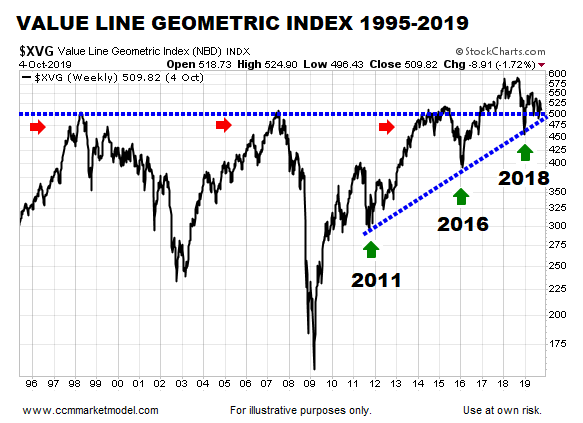
The green arrows above from 2011, 2016, and 2018 tell us the market remains near an important area that should provide additional information either way (support holds or support breaks). We will continue to take it day by day.
Which Path Will The Stock Market Take?
LOGICAL ASSESSMENT BASED ON FUNDAMENTAL AND TECHNICAL FACTS
Similar Drops In ISM Manufacturing Data
RARE AND RAPID DROP IN ISM MANUFACTURING
ISM Manufacturing PMI Index came in well below expectations on October 1, 2019 sparking renewed fear of a recession.

Given the ISM Manufacturing Index was strong in August 2018 and plunged rapidly to the October 1, 2019 level, it might be helpful to know how many similar drops from above the blue line to below the black line have occurred since 1982 and how did the stock market perform over the next five years? The answer to the first question is five previous times (see chart below).

The answer to the question how did the stock market perform over the next five years is “quite well”. In the first two years, 80% of the cases posted positive returns. All historical cases (1982-2019) posted gains after four and five years.

In the present day case, it took 1.08 years for ISM Manufacturing PMI to drop from the peak above the blue line to below the black line. As you can see in the table above, the three most similar “rapid drops in ISM Manufacturing PMI” cases were 1985, 1989, and 1995. The 2008 and 2016 cases required over four years to see a similar drop to what just occurred in a little over a year. If we isolate the similar “rapid plunge” cases, historical performance was more satisfying.

The present day case has many unique circumstances and will follow a unique path. This study simply provides some additional historical context. The bearish case for a rapid plunge in manufacturing data is easy to understand and will get plenty of coverage. These studies, based on history, tell us to keep an open mind about all outcomes from wildly bearish to wildly bullish.
EXPANDED COVERAGE IN THIS WEEK’S VIDEO
This week’s CCM video will most likely provide additional context regarding the similar historical periods shown above. CCM’s weekly video is released every Friday evening between 6 pm ET and midnight. Weekly videos can be found via CCM’s Twitter Feed, CCM’s Blog Short Takes, or the Ciovacco Capital Channel.
BUT 2019 IS SIGNIFICANTLY DIFFERENT
You can make that argument about 100% of the historical studies performed about the economy and financial markets. No two periods in human and market history have the exact same combination of fundamentals, technicals, valuations, interest rates, inflation, etc. Today is always different; that is a constant in the markets.
WHAT ABOUT SMALL SAMPLE SIZES?
The limited sample size of the similar cases above is what it is. We cannot control sample sizes. There have only been three 40%-plus declines in the S&P 500 since 1950 (1973-74, 2000-2002, and 2007-2009), which also represents a very small sample size. Are we supposed to totally ignore these major declines because of the small sample size? According to Reuters, the S&P 500 was officially launched on March 4, 1957, meaning any S&P 500 study deals with a very limited historical data set. It is what it is.
When we study rare events, we acknowledge the sample size and try to learn anything that can add value in the present day. The same concepts apply to the studies above. There are countless economic and market studies that are based on small sample sizes. Typically, the small sample size argument is only raised when the results run counter to someone’s personal opinion. When results agree with someone’s personal view, the small sample size is suddenly not a problem. If you believe a study or data set is irrelevant, there is an easy solution - ignore it.
This post is written for clients of Ciovacco Capital Management and describes our approach in generic terms. It is provided to assist clients with basic concepts, rather than specific strategies or levels. The same terms of use disclaimers used in our weekly videos apply to all Short Takes posts and tweets on the CCM Twitter Feed, including the text and images above.