Misconceptions About Volatility Can Lead To Investor Missteps

VOLATILITY IS ALWAYS STRESSFUL

With lingering concerns about trade, markets sold off Monday with all three major U.S. indexes posting intraday declines of greater than 1%.  Red screens create stress and doubt.  Therefore, it can be helpful to take a step back and check the big picture. 

In August 2016, the S&P 500's 30, 40, and 50 week moving averages told us to be open to better than expected outcomes from a long-term perspective.  The chart below shows the same moving averages as of 1:15 pm ET Monday.  The NASDAQ's chart looks even better. 

short-takes-06-25-208-spx-a.png

To give us a bearish reference point, the same weekly moving averages over a one-year period in 2007-08 are shown below.

short-takes-06-25-208-spx-c.png

The daily chart below shows the S&P 500's 200-day moving average as of 1:28 pm ET Monday.  The NASDAQ's 200-day paints a similar picture. 

short-takes-06-25-208-spx-day-a.png

To give us a bearish reference point, below is the same 200-day moving average over a one-year period in 2007-08.

short-takes-06-25-208-spx-day-b.png

SOME HISTORICAL PERSPECTIVE

In May 2003, stocks had made little progress YTD.  Despite numerous swings up and down into year-end, the S&P 500 finished with a very satisfying gain of 26.38%.  Day-to-day volatility provided little in the way of useful information between points A and B. 

short-takes-6-25-2018-2003.png

2004 featured numerous bouts of stress-inducing volatility, including the S&P 500 moving into negative territory YTD numerous times.  Patient investors were rewarded with a gain of almost 9%.  Even in the context of a longer-term bullish trend, volatility is to be expected. 

short-takes-6-25-2018-2004.png

Trying to trade between point A and point B in 2005 proved to be a difficult task. When the volatility dust settled at the end of the year, the S&P 500 managed to post a positive gain.

short-takes-6-25-2018-2005.png

2006 featured several moves above and below the S&P 500's 200-day moving average, along with a push into negative YTD territory as late as July.  Once the summer doldrums passed, stocks rallied hard into year-end providing patient investors with a satisfying gain of 13.62%.

short-takes-06-25-2018-2006.png

NASDAQ:  BUBBLE OR OPPORTUNITY?

This week's video takes a very long-term view of the NASDAQ using quarterly charts, allowing us to address the following question:

Does the NASDAQ look more like a bubble that is about to pop or a long-term opportunity for investors?


RESPECTING CONCERNS ABOUT TRADE

Based on the facts in hand today, the market's longer-term trend remains constructive.  With ongoing uncertainty related to the economic impact of trade tensions, it is important we continue to review the data day-by-day with a flexible, unbiased, and open mind. 

Red Screens vs. Big Picture

KEEPING OUR EYE ON THE BALL

As human beings, we all tend to focus on what is in front of us.  During the session on Tuesday, June 19, this is what was in front of us.

ccm-short-takes-blog-ivesting-ticker.png

GETTING A MORE BALANCED VIEW IN FRONT OF US

One of the keys to making more prudent and rational decisions is to look at more than just the red screen in front of us, which represents only one timeframe (the shortest).  It can also be helpful to think in extremes.  Let's assume the gloom-and-doomers are correct in their never-ending assertion that:

  •   Stocks are wildly overvalued.
  •   We are in one of the biggest bubbles in history.
  •   The S&P 500 is in the process of forming a major top.
  •   A trade war and the end of QE will take down risk assets.
  •   A decline in stocks on the order of 50% is just around the corner.
  •   The market leader, tech, is extremely vulnerable.

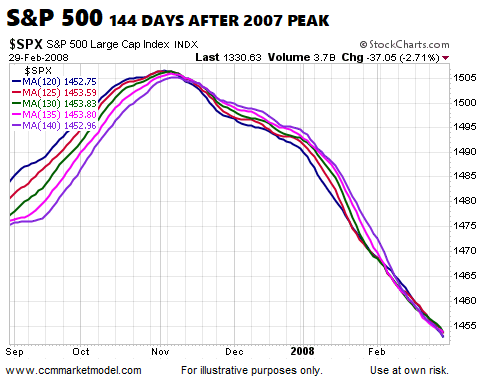
If the S&P 500's peak on January 26, 2018 (144 days ago) was the beginning of the end for the bull market, a 50% decline is coming, and the long-term uptrend in tech is ending, we would expect many market participants to be seeking shelter in safe-haven assets, such as gold, which is exactly what happened after the peak in 2007.  Notice in the chart below how the conviction to own growth-oriented tech stocks had weakened considerably relative to the conviction to own armageddon-friendly gold 144 days after the market peaked in October 2007.  The trend clearly flipped toward bearish outcomes in late November 2007; after that really bad things happened in the stock market.

short-takes-ciovacco-capital-6-19-2018-stocks-ff.png

In the 2007 case above, the S&P 500 dropped over 50% and the tech-heavy NASDAQ dropped over 55%, which aligns nicely with the gloom-and-doom forecast for 2018.  Therefore, since the chart above shows bullish conviction relative to armageddon conviction 144 days after the market peaked in 2007, if the odds in 2018 favored bearish outcomes, we would expect to see a similar and gloomy turn 144 days after the market peak in 2018, which is not the case (see below).  The present-day chart still has a full-bore bullish look, which is in sharp contrast to the full-bore bearish look 144 days after the peak in 2007.

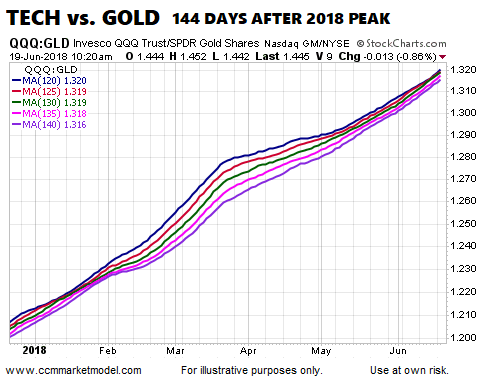
short-takes-ciovacco-capital-6-19-2018-stocks-g2.png

In 2007, 144 days after the peak, the bears were clearly in control.  In 2018, 144 days after the peak, the long-term trend clearly favors the tech bulls (QQQ) relative to the armageddon bears (GLD).  The quote below sheds some additional light on the charts above. 

Everyone is entitled to his own opinion, but not to his own facts.
— Daniel Patrick Moynihan

THE BROAD MARKET LOOKS NOTHING LIKE 2007-08

The subheading above may sound like a bold statement.  However, the statement is clearly supported by the facts.  The S&P 500 peaked on October 9, 2007. The chart below shows the same moving averages 144 days after the peak; the bears were clearly in control.

short-takes-ciovacco-capital-6-19-2018-stocks-c.png

In 2018, the S&P 500 peaked on January 26.  June 19 is 144 days after the 2018 peak in the stock market.  If the market was rolling over and heading for a 50% drop, we would expect the chart below to be taking on similar characteristics observable in the chart above, which is not the case.  In the upper right hand corner of the chart below, we can see the 25 point drop in the S&P 500 that was taking place intraday on June 19.  With some additional and longer-term context, the 25 point drop does not seem nearly as concerning. 

short-takes-ciovacco-capital-6-19-2018-stocks-b.png

MORE FACTS TO EXAMINE

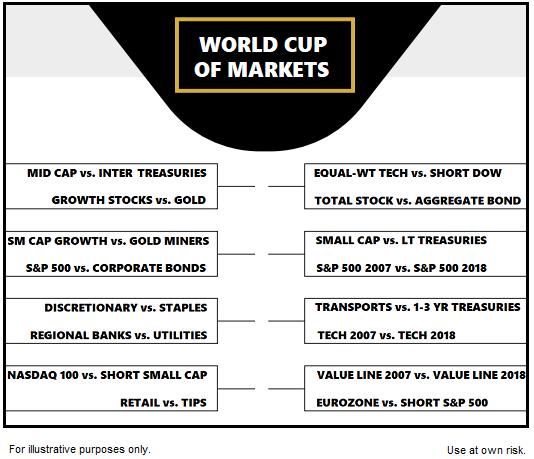
The broader the evidence, the more convincing the case.  This week's video hosts the World Cup of Markets.  The first round consists of 16 risk-on vs. risk-off matches, allowing us to get a better read on the weight of the evidence. 

short-takes-ciovacco-risk-on-vs-risk-off.png

This week's video walks through all 16 matches, giving us a better understanding of how concerned market participants are about a trade war and the end of QE.

STUDY AFTER STUDY SHOWS

If you have invested for any length of time, you have run across numerous studies that show the more often you check the markets and your account balance, the lower your returns.  For example, in the study The Effect of Myopia and Loss Aversion on Risk Taking, Thaler, Tversky, and Kahneman concluded:

“The investors who got the most frequent feedback (and thus the most information) took the least risk and earned the least money.”

REMAINING COOL, CALM, AND COLLECTED

The concepts outlined on February 6 sill apply 

While they seem unprecedented and/or unnerving while they are occurring, market dislocations are not all that rare.  Experience says those that remain cool, calm, and collected with their eye on data from multiple timeframes have the greatest chance of being satisfied with their results looking back six months from now. 

Since the close on February 5, the NASDAQ gained 10.27%. Thus far, remaining patient with an eye on the weight of the evidence, including the longer-term trends, has produced satisfying results. We will continue to take it day by day remaining open to all outcomes from wildly bullish to wildly bearish.