
Are National Financial Conditions Saying The Stock Market Is In Big Trouble?

The Chicago Fed National Financial Conditions Index allows us to better understand the present day in the context of economic and stock market history. According to the Chicago Fed, the National Financial Conditions Index provides:

“A comprehensive weekly update on U.S. financial conditions in money markets, debt and equity markets and the traditional and shadow banking systems. Positive values of the NFCI indicate financial conditions that are tighter than average, while negative values indicate financial conditions that are looser than average.”

Since the yield curve is derived from yields on U.S. government bonds that are backed by the full faith and credit of the U.S. government, the yield curve tells us very little about the market’s perception of default probabilities and counterparty risk. When the National Financial Conditions Index rises, it is indicative of decreasing trust and tighter financial conditions. When the National Financial Conditions Index is falling or at low levels, it is indicative of higher trust within the financial system and more favorable access to capital. Therefore, we can learn something about August 2019 by comparing current financial conditions to financial conditions before large drops in the S&P 500 Index.

HISTORICAL CASES

In October 1973, before the S&P 500 dropped 44%, the National Financial Conditions Index had a reading of 2.13, which aligns with much tighter than average financial conditions and lower levels of confidence and trust.

nfci1973.png

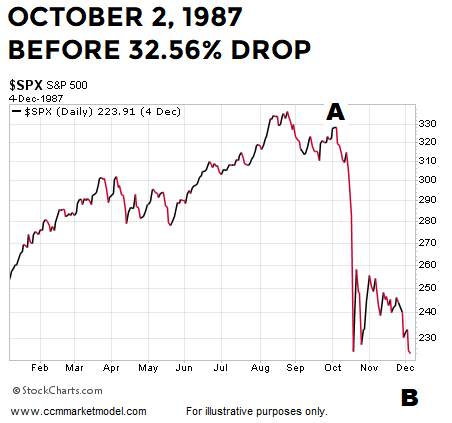
In October 1987, before the S&P 500 dropped 33%, the National Financial Conditions Index had a reading of 0.02.
nfci1987.png

In July 1990, before the S&P 500 dropped 20%, the National Financial Conditions Index had a reading of -0.20.

nfci1990.png

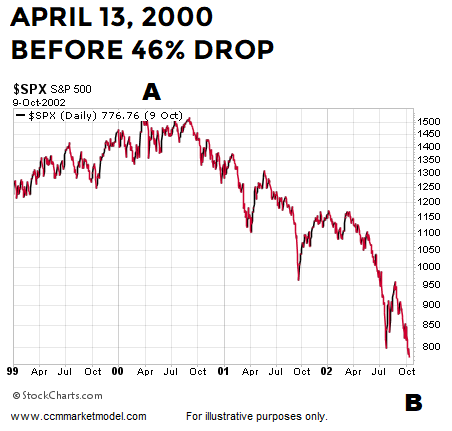
In April 2000, before the S&P 500 dropped 46%, the National Financial Conditions Index had a reading of -0.18.
nfci2000.png

In December 2007, before the S&P 500 dropped 54%, the National Financial Conditions Index had a reading of 0.32, which aligns with tighter than average financial conditions and lower levels of confidence and trust.

nfci2007.png

In July 2011, before the S&P 500 dropped 19%, the National Financial Conditions Index had a reading of -0.25%.

nfci2011.png

HOW DO FINANCIAL CONDITIONS COMPARE IN 2019?

Remember, according to the Chicago Fed, “negative values indicate financial conditions that are looser than average.” Therefore, the lower the reading the better. The last reading of the National Financial Conditions Index was posted on August 2 and came in at -0.85, which is the most favorable reading relative to the cases above by a wide margin. In fact, the August 2, 2019 reading is one of the most favorable readings seen in the last decade and looks much better than the last elevated period in 2011.

short-takes-national-financial-conditions-index-a.png

If we go back to 1990, the graph below shows current financial conditions are much more favorable than they were near recessionary periods in 1990-91, 2000, and 2007-09 (shaded areas). Concerns in the present day would increase if the National Financial Conditions Index started to spike higher, as it did in July 2007.

national-financial-conditions-index-today.png

YIELD CURVE AND BIGGER PICTURE

The 10-2 yield curve is moving closer to inversion, which means market participants believe the Fed is on the verge of what could be multiple rate cuts in the coming months. Since the yield curve has been covered by the media for over two years, it is possible 10-2 yield curve inversion could trigger some heavy selling, especially in the short run. If credit spreads begin to widen in a material manner and the National Financial Conditions Index begins to rise closer to the -0.10 to 0.30 range (last 2019 reading was -0.85), stock market concerns would increase. Given present day financial conditions remain constructive relative to history and given the material covered in this week’s stock market video, it is prudent to remain open to all outcomes.

BULL/BEAR GUIDEPOSTS

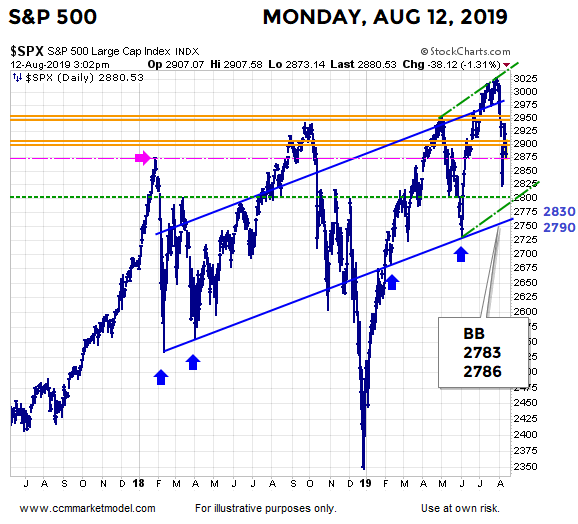
As noted last week, it would not be surprising to see the S&P 500 revisit the 2790 to 2830 area. At the end of last week, some notable Bollinger Band levels sat at 2783 and 2786. On Monday afternoon August 12, the S&P 500 was trading above all these levels at 2880. From a probability perspective, we will learn something either way (market holds, market drops below and holds below these levels).
ccm-market-model-ciovacco-spx-aug-12-2019.png

A Rare Selloff On Wall Street

BOUNCE ATTEMPT POSSIBLE IN COMING DAYS

According to breadth data from stockcharts.com, Monday’s session featured the lowest intraday NYSE Advance-Decline Volume reading in history. Given total market volume has changed significantly over the past 80 years, it is more relevant to compare Monday’s selloff to the recent past (chart below).

short-takes-nyus-ciovacco-2019-BCORRECTED.png

The last intraday reading in the ballpark of Monday’s came on December 24, 2018. We all know Christmas Eve 2018 marked an important low. Is it possible for a market that reached such an oversold state to keep dropping? Yes, however, from an odds perspective, it would not be shocking to see at least a significant bounce in the coming days. The table below shows what happened in the stock market after extremely low NYSE Advance-Decline Volume intraday readings in 2010, 2011, 2016, and 2018. In all four of the recent cases, the S&P 500 was higher seven calendar days later by an average of 5.01%.

short-takes-spx-cgc-2019-12.png

The Senior Loan ETF, which was helpful in January 2019, was able to rally into Monday’s close and finish flat for the day. The 10-2 yield curve also improved Monday (moved further away from inversion).

short-takes-nyus-ciovacco-2019-d.png

As pointed out on the @OddStats Twitter Feed, it is extremely rare for a Monday to be down more than 2% when the previous week ended with three red sessions of 0.70% or more. It has occurred eight other times since 1950. The table below shows stock market performance was positive after 14 calendar days in all of the historical cases since 1950.

short-takes-spx-cgc-2019-13.png

Our allocations, which include the cash raised last week, bonds, and gold, remained in line with the data at Monday’s close. Additional adjustments may be called for, especially if the S&P 500 fails to make a stand somewhere between Monday’s close and 2750-ish. The blue and green lines below come in between 2770 and 2800-ish. The S&P 500’s weekly chart has a lower Bollinger Band at 2776; the monthly Bollinger Band centerline currently sits at 2782. All of these guideposts are within 3.3% of Monday’s S&P 500 close.

short-takes-nyus-ciovacco-2019-F.png

Monday’s close came near the 61.8% retracement of the rally that began in early June.

short-takes-ciovacco-spx-20.png

Monday’s close also came near an area that featured four gaps (blue arrows below). While these gaps have been filled, it still tells us the market has deemed this general area to be important in the past.

short-takes-ciovacco-spx-21.png

Another possible guidepost comes on the weekly chart of stocks (SPY) versus bonds (TLT). The ratio has made a stand near Monday’s close on several occasions. At the end of the week, we will learn something either way (bullish or bearish).

short-takes-nyus-ciovacco-2019-G.png

UNTIL THE MARKET CAN MAKE A STAND, CONCERNS REMAIN

This week’s video outlines numerous short-term developments that prompted some profit-taking and defensive positioning last week. Monday’s session did not alleviate these concerns.

LOW, BOUNCE, OR BEARISH BREADTH THRUST

Given our current allocations, model readings, rare oversold nature at the end of Monday’s session, and the fact that potential support is within 3.3% of the close, it was prudent to see if the market can try to make a stand or bounce in the coming days. The concerns outlined in this week’s video remain, and we have to expect that rare and lopsided breadth sessions are most often found near lows, but they can also surface in the early stages of declines that still have room to run. Therefore, it is extremely important that we keep all options on the table, including selling into strength on what could be a short-lived bounce attempt. As shown in the chart below, the S&P remains above an upward-sloping 200-day moving average. The market recently made a higher high and has yet to print a lower low. For now, we must balance the very concerning short-term data/facts with the still constructive longer-term facts.

short-takes-nyus-ciovacco-2019-GB.png

The chart below also aligns with the possibility of the market trying to make a stand in the coming days. The percentage of NYSE stocks above their 200-day exponential moving average is sitting near an area where the S&P 500 made a bullish stand twice in 2016 (see first two blue arrows and green lines). The blue dotted line shows the reading at the S&P 500’s June 2019 low. Like all the charts above, we will learn something either way.

short-takes-nyus-ciovacco-2019-GBNn.png

This post is written for clients of Ciovacco Capital Management and describes our approach in generic terms. It is provided to assist clients with basic concepts, rather than specific strategies or levels. The same terms of use disclaimers used in our weekly videos apply to all Short Takes posts and tweets on the CCM Twitter Feed, including the text and images above.