Global Dow Nails Down Bullish Signal

SIGN OF GROWING CONFIDENCE

At the end of November, monthly CCI completed a momentum round trip by closing above 100 after closing below -100 in late 2018. CCI helps us track market momentum. The turn that just took place over the last year is typically associated with a significant shift from pessimism to optimism as it relates to investor perceptions of future economic and market outcomes.

chris-ciovacco-short-takes-ciovacco-capital-ccia.png

HISTORY SAYS THIS SIGNAL INCREASES LONG-TERM BULLISH ODDS

If we look at the same Global Dow chart on a much longer timeframe, we get a better understanding of the possible significance of the recent signal. The blue arrows below indicate similar turns in monthly CCI have occurred near major lows in the Global Dow. The bottom portion of the chart shows long-term S&P 500 performance was favorable following past “highly pessimistic to optimistic” moves in monthly CCI.

ciovacco-capital-management-short-takes-cci.png

EVIDENCE OF INSTITUTIONAL SUPPORT FOR STOCKS

Large institutions tend to move markets. If large institutions thought the long-term outlook for stocks and the global economy was highly negative, it is unlikely the chart of the Global Dow would see a bullish turn in monthly momentum similar to what just took place over the past year. Keeping in mind this signal helps us with long-term odds, the table below shows very favorable historical outcomes for the S&P 500 looking out one to four years.

chris-ciovacco-short-takes-ciovacco-capital-ccia2.png

HISTORY SAYS THE S&P 500 COULD BE HEADED TO 3600

This week’s stock market video explores realistic expectations for both upside potential and volatility looking out 1-2 years.

SIGNS OF GLOBAL ECONOMIC STABILITY

The trade war has raised concerns about slowing manufacturing activity around the globe. Recent economic data from China seems to align with the story being told by the monthly chart of the Global Dow. From The Wall Street Journal:

“There have been positive signs from other regions. In China, the private Caixin manufacturing purchasing managers index notched its fourth straight month of growth in November, bolstering the case that factory activity in the world’s second-largest economy has stabilized after a decline.”

Investors Run From Stocks At Record Pace

BIGGEST WITHDRAWALS ON RECORD

There is a lot of relevant information in the text below from a Wall Street Journal article dated December 8, 2019:

“Investors have pulled $135.5 billion from U.S. stock-focused mutual funds and exchange-traded funds so far this year, the biggest withdrawals on record, according to data provider Refinitiv Lipper, which tracked the data going back to 1992.”

DOES 2019 LOOK ANYTHING LIKE THE MAJOR PEAK IN 2000?

Given we know extreme sentiment can be a powerful contrary indicator, we would expect exuberant investors to rush into stock-based investments near a major stock market peak, which is exactly what happened in the year 2000. From a Federal Reserve Bulletin dated December 2000:

“Mutual fund investors returned vigorously to equity funds, increasing the pace of net new cash flows into those funds to a record level over the first eight months of 2000.”

Keep in mind, the S&P 500 peaked in March 2000 and investors were still adding to stock-based funds at a record pace through the end of August 2000, which looks nothing like what we have seen in 2019.

HOW DOES 2019 COMPARE TO OTHER PERIODS?

As shown on December 2, when investors made a mad dash for the equity fund exits, it occurred near major stock market lows in 2002, 2009, 2011, and 2016.

fund-flows-bnp-graph.png

We just experienced heavy equity fund outflows in 2019, similar to the periods shown in the graph above. How did the S&P 500 perform walking forward from December 2002, March 2009, December 2011, and July 2016? The answer is in a manner that looks nothing like a major stock market top.

Fund Flows SPX A.png

TEN NEW STOCK MARKET SIGNALS

This week’s stock market video covers ten “this just happened in 2019” signals. The video also takes a look at the blow-off top cases cited in a recent CNBC article.

DAY BY DAY

The market still has trade-related hurdles to contend with between now and December 15, reminding us to walk forward with a flexible, unbiased, and open mind. The fund flows data above simply helps us with historical perspective on what has taken place in 2019. From The Wall Street Journal:

“There’s not a lot of faith in this market,” said Scott Wren, a senior global equity strategist at Wells Fargo Investment Institute. “There’s no chasing going on. Usually before you hit the top in a cycle, there’s a lot of chasing and fund flows are higher.”

New Signal Supports Bullish Secular Trend Thesis

WEIGHT OF THE EVIDENCE

Common sense tells us, even in the strongest of strong bull markets, we can find concerning data points and scary narratives. There is always something to be concerned about. Markets move based on the weight of the evidence. Therefore, we are constantly evaluating present-day data points and looking for signals that confirm or contradict the bullish hypothesis that was formed in early January 2019.

tv small.png

THIS JUST HAPPENED

The only way we can really understand if a signal leans bullish, bearish, or neutral is to ask and answer the following question:

How many times has it occurred in the past and how did the stock market perform after past signals?

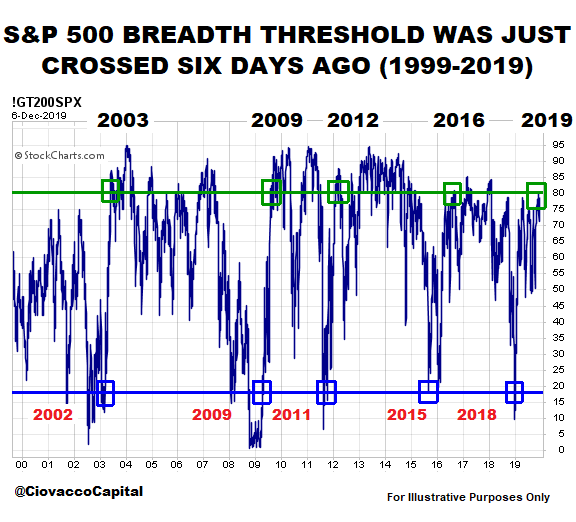
The chart below shows the percentage of S&P 500 stocks above their 200-day exponential moving average. It is rare for this breadth indicator to drop below the blue line, which is indicative of extreme pessimism about future economic and market outcomes. If you know market history, you know most signals that began to form in 2002, 2009, 2011, and 2015 turned out to be great “keep an open mind about better than expected outcomes” signals. The signal shown below is triggered when breadth gets oversold (below the blue line) and then makes it all the way back to the green line. The last round trip took place between late December 2018 and late November 2019.

ciovacco-capital-research-chris-kathy-breadth.png

HOW DID STOCKS PERFORM WALKING FORWARD?

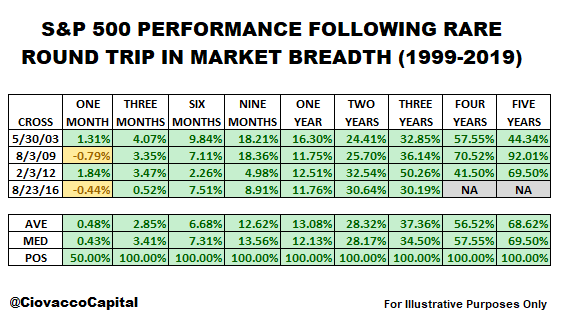
Rather than waiting for something to happen (i.e. market to make a top), the table below is based on something that just happened. In the previous cases, and based on all the data available, subsequent S&P 500 performance was very satisfying looking out three months to five years.

ciovacco-capital-research-chris-kathy-breadth2.png

Continuing with the weight of the evidence theme, ten new signals and S&P 500 performance tables are covered in the video below.

DOES THE BLOW-OFF TOP THEORY HOLD WATER?

The hot topic on Wall Street this week was “blow-off top”. How concerned should we be about an end to a euphoric stock market rally? You can decide.

REALISTIC EXPECTATIONS

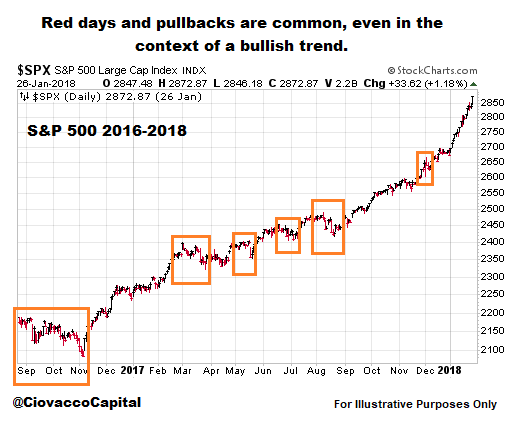
Was it a cake walk after the breadth thrust round trip that was triggered on August 23, 2016? No, reminding us that even under a longer-term bullish scenario, really scary periods are to be expected.

Red Days Are Common Normal Volatility.png

PREVIOUS SIGNALS ALIGN WITH SIGNALS ABOVE

The Seeking Alpha posts below provide additional support for the longer-term bullish case:

Financial Conditions: Today vs. 1974, 1987, 2000 And 2007

Are Financials Hinting At 2011/2016-Like Stock Market Rally?

Extremely Rare Extended Condition In Bonds: What Could It Mean For Stocks

DAY BY DAY

We will continue to test the cyclical low (December 2018) in the context of a secular trend thesis in upcoming posts and videos. If the weight of the evidence begins to shift in a bearish manner, we must be willing to adjust our assessment of the probabilities.