
Reversals And Countertrend Moves Typically Take Time To Develop

HUMAN NATURE AND PLUNGES

Since investor psychology tends to be similar after a sharp plunge in the stock market, subsequent bottoms and/or countertrend rallies often share similar characteristics. The first three cases below all show investor behavior following a sharp 20% plunge in a non-recessionary environment.

The 1987 case featured a sharp oversold rally of 18.82% and a retest of the original low 45 calendar days later.

short-takes-ciovacco-1-7-2019-1987.png

The 1998 case featured a sharp oversold rally of 13.42% and a retest of the original low 37 calendar days later.

short-takes-ciovacco-1-7-2019-1998.png

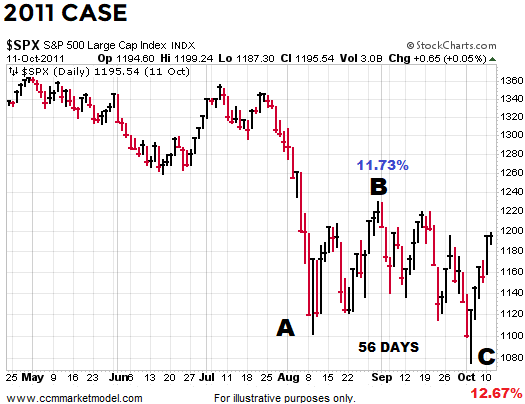
The 2011 case featured a sharp oversold rally of 11.73%% and a retest of the original low 56 calendar days later.
short-takes-ciovacco-1-7-2019-2011.png

RECESSIONARY CASE

As we have noted in the past, the initial plunge in 2007 also shares some similarities to 2018-19. In the 2008 case, the plunge was followed by a 9.92% rally. The previous plunge low was retested 54 days later. Following the successful retest, the S&P 500 rallied 13.43% before the countertrend rally ended on May 16, 2008.

short-takes-ciovacco-1-7-2019-2008.png

MORAL OF THE STORY

Respecting 2019 will carve out a unique path, it is possible human nature will once again produce a period of volatility and consolidation in the wake of the December 2018 plunge. Thus far, the current oversold rally seems to align with the historical cases shown above. Therefore, it would not be surprising to see the S&P 500 rally back to the 2600 to 2670 area before retesting the December 2018 low sometime in the next three to six weeks (late January to mid-February) - all TBD.

short-takes-jan-7-2019-spx.png

HOW MARKETS/PROFILES TYPICALLY TURN FOLLOWING PLUNGE

When markets plunge, profiles tilt heavily to the bearish-trend side of the ledger, which is still the case in 2019. For any type of sustainable rally to take place, it typically takes time for the data/trends to stabilize/consolidate, allowing them an opportunity to turn back up after a retest of the original low. The basic concept is illustrated via the 50-day moving average in the 2008 case below. The market’s profile/hard data is extremely weak near the first low (red arrow). After the retest of the low, the period of consolidation/confusion allowed the data to stabilize and subsequently turn back up (blue arrow).

short-takes-retest-math.png

Our purpose is not to forecast any outcome in 2019, but rather to understand and respect a wide range of outcomes, including a V-bottom or failed retest of the December low, followed by much lower lows. The market remains in a downtrend until proven otherwise.

MORE DETAIL IN VIDEO

Maximum Flexibility

SOME SIGNS OF LIFE

It is too early to read too much into the last two days, but we can acknowledge some observable signs of what could be the early stages of an attempt to form a lasting bottom.

Wednesday’s massive, rare, and impressive candle was followed by a 91 point intraday reversal in the S&P 500 today. We have been saying in order to consider migrating from a defensive/principal-protection posture to a more balanced stance, we need the market to show us something. The last two sessions provide evidence of some improvement on the risk-taking relative to risk-aversion front.

short-takes-ciovacco-12-27-2018.png

BONDS: A FAILED BREAKOUT?

Given the S&P 500 remained in an oversold position, we purposely added a relatively small percentage stake to defensive bonds, knowing a rally in stocks could be coming soon. In a short-term narrative that aligns well with the S&P 500’s improvement in the last two days, bonds (TLT) could possibly be in the process of experiencing a failed bullish breakout. If the breakout indeed fails, which is still to be determined, TLT could see increased selling pressure in the days ahead. Therefore, we reduced our exposure to TLT before Thursday’s close.

short-takes-ciovacco-12-27-2018-9.png

TLT was up over 1.00% intraday Thursday (doing well when stocks were getting hammered) and looking like it was going to print a convincing breakout. When stocks staged the impressive intraday rally, TLT moved to more of a “this breakout could be failing” look and closed with a tiny gain of 0.02%.

MAY MOVE TO A MORE BALANCED APPROACH

If the S&P 500 can stay out of free-fall mode and can continue to show signs of what looks like a possible bottoming process, the model will have us move to a more balanced approach in the short run. If we can add a nominal amount of equity exposure, it will allow us to have a modest exposure to both sides of the equation (growth and defensive). The market’s profile has sustained so much damage that cash will remain a fairly substantial part of the equation until the data improves.

This weekend’s video will outline the rationale for having a cash/bond/stock mix and why it would allow us to be more flexible and patient in the weeks and months ahead. It is possible stocks and bonds will alternate between periods of leadership; that could be true in a devastating bear market scenario (see example below) or a “stocks are trying to form a lasting bottom” scenario. Once things calm down a bit, the model prefers to be in a more neutral vs. one-sided stance. The stock market still needs to show additional signs of improvement (TBD).

short-takes-ccm-24 rty.png

GETTING TO THE RIGHT PLACE CAN BE MESSY

Corrections, bear markets, and the process of forming a lasting bottom can all lead to frustrating volatility and whipsaws. The recent 2018 plunge could lead to much lower lows in stocks or a bottoming formation. In either case, a period of sideways confusion and consolidation could be coming in the weeks/months ahead. A mixed cash/bond/stock allocation could help us be patient, allowing the market to digest the recent plunge before deciding which way the next trending period will break.

This weekend’s video will provide numerous “hang in there during the messy period” examples that occured in bear markets and sharp corrections. Messy periods are often followed by much cleaner periods marked by stronger trends, along with a sharp reduction in whipsaws, frustration, aggravation and trading frequency. For example, whipsaws (bad trades) were common during the bottoming process in 2011. Eventually, the frustration was followed by a “forget the whipsaws” gain of over 97%. This too will pass. The market will decide how, which way, and when.

short-takes-2011-stock-market-crash.png

MORE DETAILS COMING IN WEEKEND VIDEO

The video will try to address additional questions that clients may have in this environment.

This post is written for clients of Ciovacco Capital Management and describes our approach in generic terms. It is provided to assist clients with basic concepts, rather than specific strategies or levels. The same terms of use disclaimers used in our weekly videos apply to all Short Takes posts and tweets on the CCM Twitter Feed, including the text and images above.