Stock Market Near Key Support Band

Holding Above Logical Area

The NYSE Composite ($NYA) chart below contains Anchored Volume Weighted Average Price lines (AVWAP). AVWAP assists with support and resistance, and more importantly, whether buyers or sellers control the market. Sellers took control of the market in Q1 2022 and maintained control until Q4 2022. Since the October 2022 low, buyers have slowly and incrementally regained control. Since the SPDR S&P 500 ETF (SPY) is highly correlated to the NYSE Composite Index, the developments below speak to an improved outlook for SPY.

Bull/Bear Battle Lines

A zoomed in version of the same NYSE AVWAP chart shows three key levels (A, B, and C). Between early January and late June 2023, sellers stepped up their conviction when price popped above the upper AVWAP band. Since early July, the market's tone has shifted. Rather than attracting sellers between points A and B, buying conviction has increased, allowing price to spend more time above the important AVWAP band. Bearish concerns for SPY would increase if sellers drove the NYSE Composite below points B and C, which sit roughly 4-8% below where the NYSE was trading during Monday' session.

A significant step for the bullish case would be to print a higher high by exceeding the July 2023 high. For now, the bulls have the advantage, but in a still-vulnerable manner.

Time For Laggards To Play Catch Up?

The NYSE Composite has been a laggard in 2023; the same can be said for the Dow Jones Industrial Average. The chart of the SPDR Dow Jones Industrial ETF (DIA) below was first shown in a July 21 article to demonstrate DIA could be in the early stages of a new bullish trend.

If we look at an updated version of the DIA chart (below), the third step for a probabilistic bullish trend change that was completed in July is still relevant. Thus far, DIA has consolidated above the Q4 2022 high and an upward-sloping 200-day moving average. In 2022, DIA spent a good part of the year below a downward-sloping 200-day. In 2023, DIA has spent most of the year above a flattish-to-upward-sloping 200-day moving average, which is indicative of a favorable longer-term trend.

Conviction Sides With Bulls

Charts are a reflection of human behavior. A noticeable shift in behavior has taken place on the DIA AVWAP chart below. In the first half of 2022, selling conviction increased near the downward-sloping red AVWAP line tied to the 2022 high. The conviction of buyers and sellers became more balanced between June and October 2022, allowing DIA to make a stand near the orange and dark blue AVWAP lines from the COVID high and low. Since late 2022, DIA has spent a considerable amount of time above both the red AVWAP line tied to the 2022 high and the light blue AVWAP line tied to the October 2022 low, telling us that market participants have more confidence about future economic and market outcomes in 2023 relative to 2022. In its present form, the chart below says the 2022 bear market is over and the rally off the October 2022 low is still intact.
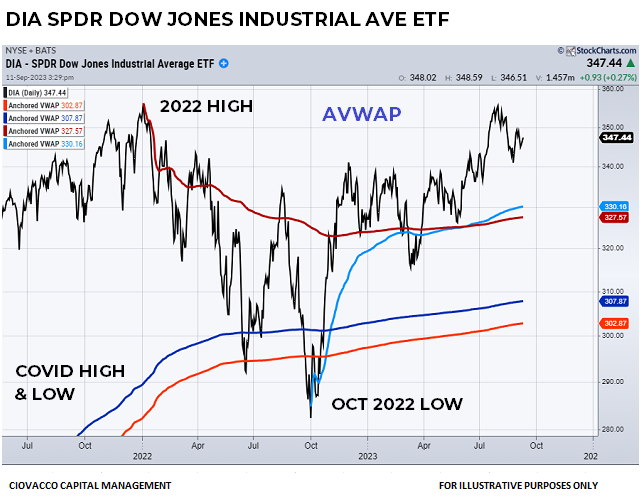
DIA has lagged SPY in 2023. Evolving bullish evidence in laggards ($NYA and DIA) is a good sign for market leaders, including SPY.

Secular Trends and Demographics

The charts above align with the market's long-term trend, favorable demographics, and recent signals from high yield bonds and the NASDAQ 100, telling us to keep an open mind about better-than-expected outcomes between now and 2035.

Moral Of The Story

In recent weeks, sellers took control of the short-term trend, but thus far have done little to flip the longer-term trend script. Consequently, we will continue to give the primary bullish trend the benefit of the doubt until the evidence shifts in a meaningful manner.

High Yield Signal Does Not Align With Long-Term Bearish Outcomes

High Yield Flips Cloud Script

The weekly Ichimoku Cloud chart below for the SPDR Bloomberg High Yield Bond ETF (JNK) shows a trend that rolled over in early 2022, formed a base in 2H 2022, and resumed an uptrend in 2023. Ichimoku Clouds look complex, but they are easy to understand. For the purposes of this discussion, the weekly trend is down when the “Bearish Odds Increase” conditions are in play and the weekly trend is up when the “Bullish Odds Increase” conditions are met (key bottom of image).

Bullish Turn July 2023

The look of the JNK chart below checks all the bullish boxes (green > price, price > red, blue > red, price > cloud, and cloud flips from red to green). The weekly close on July 21, 2023, was the first time all the bullish boxes could be checked since November 19, 2021, which speaks to increasing confidence about future economic and market outcomes. The fact that price, green, blue, and red are all above the cloud speaks to the strength of the trend and margin of safety.

Rare Bullish Flip

As shown in the chart below, a bullish move that sees price push back above a red cloud has only occurred two previous times in JNK’s history. We will examine the two previous cases to see what we can learn about risk and reward in 2023.

Sentiment Improves After GFC

Like many asset classes, high yield bonds were hit hard during the 2008 global financial crisis (GFC). Economic confidence began to improve in 2009, allowing JNK to check all the bullish boxes on September 18, 2009, which is similar to what occurred on July 21, 2023. The fact that price, green, blue, and red are all above the cloud speaks to the strength of the trend and margin of safety.

Since an improving weekly trend in high yield bonds speaks to decreasing concerns about a recession and bond defaults, we would expect risk assets to see improved performance after JNK completes a bearish to bullish flip. The SPDR S&P 500 ETF (SPY) gained 124% between September 18, 2009, and July 17, 2015. There were a significant number of normal and to be expected countertrend moves (give backs & corrections) between points A and B on the chart below, reminding us of the importance of maintaining realistic expectations about how markets operate in the real world.

2016: Economic Fear Subsides

Risk assets suffered significant drawdowns between mid-2015 and Q1 2016. Following the 2016 lows, increasing confidence in the credit markets was evident on August 12, 2016, when JNK was able to check all the bullish boxes, indicative of a much-improved weekly trend. The fact that price, green, blue, and red are all above the cloud speaks to the strength of the trend and margin of safety.

When the conviction of buyers is greater than the conviction of sellers in the high yield bond market, it speaks to confidence about future economic outcomes. 2016 was no exception with SPY gaining an additional 35% between August 12, 2016 and January 26, 2018.

QQQ and XLK After JNK’s Trend Flipped

In each of the three cases below, JNK dropped below a red cloud while checking all the bearish boxes and then pushed back above a red cloud and checked all the bullish boxes:

Case 1:  September 18, 2009

Case 2:  August 12, 2016

Case 3:  July 21, 2023

As shown in the table below, in the historical cases that featured significant drawdowns in risk assets followed by a significant recovery in JNK (cases 1 and 2), risk assets performed in a satisfying manner for those who endured normal volatility along the way.

High Yield Remains In An Uptrend

The more traditional JNK chart below with the 10, 20, and 40-week moving averages shows confidence in the high yield market remains on firmer footing relative to the vulnerable look in early 2022. If the September 2023 chart morphs into a look similar to early 2022, concerns about the sustainability of the rally would increase. That may happen very soon, but it hasn’t happened yet.

Know Your Timeframe

The timeframe of this analysis is important. It says little about whether the next 5% move in SPY is up or down. The analysis is helpful for investors with a long-term time horizon (years rather than days, weeks, or months).

Skepticism Is Part Of The Historical Script

While confidence had improved by the time the JNK signals were generated in 2009 and 2016, there was still a very healthy does of skepticism in both cases. In September 2009 market participants had the painful GFC fresh in their minds and not many would have guessed SPY would return 124% over the next 5-6 years. In the 2016 case, investors were dealing with uncertainty related to growth, interest rates, and the November elections, and yet SPY tacked on an additional 35% over the next 1.5 years. Thus, if you are skeptical today, that aligns with the 2009 and 2016 cases.

Moral Of The Story

In JNKs relatively short history, the signal generated on July 21, 2023, has only occurred two previous times, September 18, 2009 and August 12, 2016; in both cases the market’s final low was in place and investors who withstood normal market volatility were rewarded with satisfying returns. In the 2009 case, SPY gained an additional 124% over the next 2,228 calendar days. In the 2016 case, SPY gained an additional 35% over the next 532 calendar days. The returns for XLK and QQQ were constructive as well, simply telling us to keep an open mind about much better than expected outcomes in the next one to five years, which aligns with a recent QQQ signal, demographics, and long-term stock market trends.

Nasdaq 100 Signal Says Stocks Could Post Impressive Multi-Year Gains

Long-Term Buying Opportunity

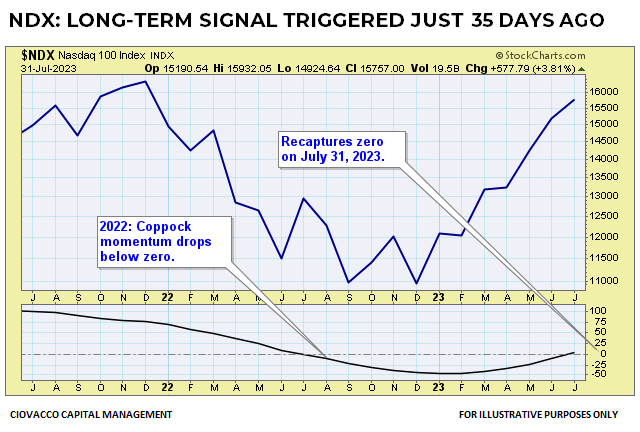
Thirty-five calendar days ago, the NASDAQ 100 triggered an extremely rare long-term momentum signal that should be of great interest to long-term investors. According to Stockcharts.com, “The goal of the Coppock Curve is to identify long-term buying opportunities,” which speaks to margin of safety when putting hard-earned capital in harm’s way.

Rare Buy Signal

In 2021, with market participants growing increasingly concerned about inflation and Fed policy, longer-term momentum began to slow in the NASDAQ 100, the index tracked by the Invesco NASDAQ 100 ETF (QQQ). Multi-year prospects began to improve in Q1 2023 when the Coppock Curve turned back up. A long-term buy signal was triggered on July 31, 2023 when the Coppock Curve moved back into positive territory.

QQQ has a high correlation to the U.S. stock market and the technology sector, thus, this signal provides insight into the long-term investment prospects for the SPDR S&P 500 ETF (SPY) and the Technology Select Sector SPDR ETF (XLK).

How Rare and What Happened In Subsequent Years?

The NASDAQ 100 officially launched on January 31, 1985. Over the past thirty-eight years, a monthly Coppock buy signal has only been flashed four previous times. Since improving long-term momentum reflects expectations related to every fundamental topic you can think of, including valuations, earnings, general economic conditions, health of the credit markets, interest rates, inflation, and Fed policy, it is helpful to review each historical case to see what we can learn about the investment prospects for QQQ, XLK, and SPY in September 2023.

Sentiment Improves After 1987 Crash

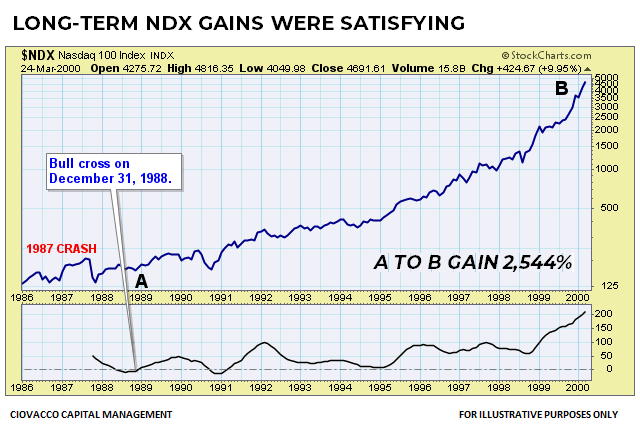
After the 1987 stock market crash, there were lingering questions about the stability of the U.S. economy and financial markets. NASDAQ 100 momentum began to turn more constructive in 1988 and a rare Coppock Curve buy signal was triggered on December 31.

While volatility remained part of the investment equation, the NASDAQ 100 presented investors with a rare long-term opportunity by posting a gain of 2,544% between December 31, 1988 and March 24, 2000.

Momentum Turns After 1990 Concerns

Investors were concerned about a recession following the 1987 crash, however, the National Bureau of Economic Research (NBER) did not declare a recession until several years later on April 25, 1991, stating that an economic contraction began in July 1990 via the press release text below:

CAMBRIDGE, April 25 - The Business Cycle Dating Committee of the National Bureau of Economic Research reached the judgment today that the peak of US economic activity occurred in July 1990. The current US recession thus began in July 1990, in the committee's view.

Thus, an investor that was waiting for a recession probably did not pay much attention to the bullish Coppock Curve signal that triggered on March 28, 1991, 28 days before the recession was officially declared. The market had already discounted the recession via the declines that occurred in 1990.

The stock market was looking to the future after the 1991 Coppock Curve buy signal. Following the rare turn in bullish momentum, the NASDAQ 100 posted an impressive gain of 1,671% before the market peaked on March 24, 2000.

Buy and Hold Is Not Easy

There are times when buy and hold investing seems easy and clearly the only way to go. Unfortunately, nothing is easy in the financial markets as evidenced by the 83% decline in the NASDAQ 100 between March 24, 2000 and the bear market low on October 9, 2002. Did the Coppock Curve flash any long-term buy signals in this painful investing window? No, which makes the 2023 signal even more compelling.

New Dawn After Dot-Com Bust

As you might imagine, after an 83% decline, investors were not as enthusiastic about the merits of technology when sentiment began to slowly improve in late 2002. Long-term NASDAQ 100 momentum finally flashed a Coppock Curve buy signal on August 29, 2003.

The gains following the signal were still extremely rewarding with the NASDAQ 100 posting a return of 61.89% between points A and B on the graph below.

Coppock Curve During The Financial Crisis

The most useful indicators are helpful in bullish and bearish situations. Thus, it is helpful to know what the Coppock Curve was saying during the Global Financial Crisis (GFC). The signal that just occurred in 2023 was never triggered in the 2007-2009 bear market window.

Opportunity Following GFC

Somewhat similar to the abrupt turn in momentum following the NASDAQ 100’s December 28, 2022 bear market low, Coppock momentum began to improve rapidly in Q1 2009 and crossed the monthly zero line on December 31, 2009.

The returns following the rare bullish reversal in 2009 were impressive with the NASDAQ 100 gaining 369% between December 31, 2009 and December 31, 2019.

Comparing Periods In Dollar Terms

If you are looking for a magical system, indicator, moving average, or stock market signal, you will be on an endless and frustrating journey. Nothing is magical, including the Coppock Curve. Having said that, systems, indicators, moving averages, and signals can help with the assessment of the odds of good things happening relative to the odds of bad things happening as illustrated in the two contrasting tables below:

The median NASDAQ 100 gain following the four historical monthly Coppock Curve buy signals was 1,020%. Hypothetically, a $1,000,000 portfolio would have grown to $10,202,644. No monthly Coppock Curve buy signals were flashed during the 2000-2002 and 2007-2009 bear market windows. The median outcome in the bearish windows was a loss of 67%.

Long-term Opportunity: QQQ, XLK, SPY

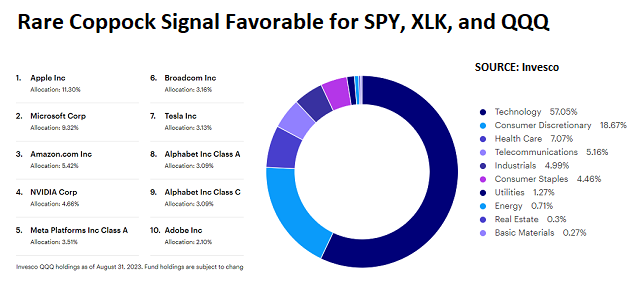
The recent bullish signal for QQQ (NASDAQ 100) is also favorable for the technology sector since QQQ has a 57% exposure to tech. SPY is also heavily influenced by tech with a sector (XLK) exposure of 28.75%.

Is it possible other sectors will outperform tech in the coming weeks and months? Sure it is, but the long-term trends unquestionably are in favor of productivity-enhancing and earnings-producing technology.

LONG-TERM MEANS LONG-TERM

A monthly Coppock Curve buy signal speaks to the coming years. It says very little about the next six days, six weeks, or six months.

FACTS ARE COVERED ABOVE

The signal generated on July 31 is a fact. The market’s performance following the historical signals is a set of facts. The purpose of reviewing the facts is to help us better understand probabilistic outcomes, which are significantly different from a prediction or forecast. We will continue to take it day by day with an open mind about a wide range of outcomes.

The Weight Of The Evidence Builds Over Time

The favorable long-term signal for QQQ aligns with the U.S. stock market being in a demographically-driven secular bull market that could last until 2034 or 2035.

Moral Of The Story

Based on a rare long-term momentum buy signal that was flashed for QQQ (NASDAQ 100), the margin of safety equation looks much more favorable today. As evidenced in August 2023, volatility and give backs are a normal part of all trends, including the current favorable trends in QQQ, XLK, and SPY.